

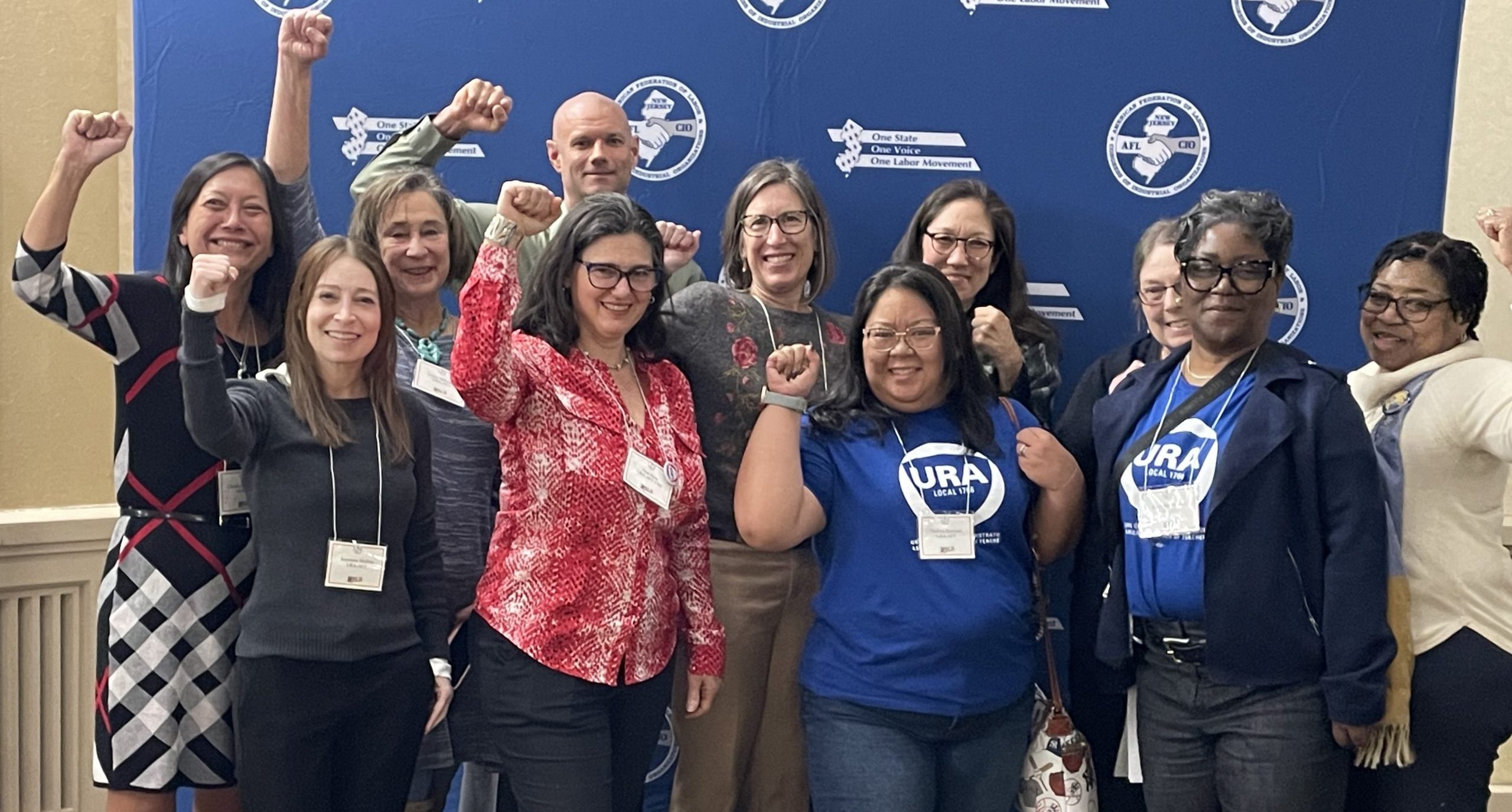
URA-AFT members attended the 19th Annual Women In Leadership Development (WILD) Conference in East Brunswick on Friday night and Saturday, March 7 and 8, 2025. They were asked what lessons will be applicable back in our unit and the broader movement for equality.
Jeannette Mullins: I went to be inspired by successful women and to learn from the presentations. All the guest speakers, such as Rebecca Damon, Christyne Neff, and Janet Gerhard were inspirational. We need to place a greater focus on wellness and overall health. It was a very comfortable event – there were so many women there for the same reasons I was. The gender pay gap is still not okay at all. For every dollar a man makes, women make only $.85. (Note: Gender pay gap remained stable over past 20 years in US | Pew Research Center). In the current political climate, we discussed the value of the leadership skill of simply listening to each other as women living in the same world, trying to receive fair equitable pay and treatment.
Jessica Hunsdon: Higher education and URA workers are under serious attack by this federal administration. As we learned in the workshop titled, Sharpening the Leadership Tools we Need for this Moment, I am committed to working within and across our unions at Rutgers to break down “silos,” connect across all worker job type and categories, and build a powerful solidarity. We can only face these serious challenges together by communicating clearly, developing collective and meaningful solutions, and taking action.
Christine O’Connell: The strongest emotion I felt at the conference was pride. Pride that over 200 union women from labor across various occupations, plumbers, electricians, carpenters, nurses, teachers, and URA staff find commonality in our struggle together. The more time I spend with these women, the more I learn.
Jo Nagle: The WILD conference is an eye opener for newer members and a great reminder for seasoned members to see the breadth of our important affiliation with the AFL-CIO and our sister unions. Now more than ever, the labor sector needs to be united to continue to advocate for workers’ rights. Senator Andy Kim explained that his “north star” is his children – he does what he does to make our country better for them and all of us. Rebecca Damon (SAG-AFTRA) and Christyne Neff (first woman chief of staff for the AFL-CIO and UFCW member) reaffirmed that women can be leaders in what is perceived as predominantly male industries. Janet Gerhard (FHE Health) was hilarious as she exhorted everyone to take care of themselves. The conference also served as a reminder of the importance of voter registration. More than 200,000 people were removed from the New Jersey voter registration rolls for not voting in federal elections (Note: N.J. drops nearly 225,000 from voter rolls). Finally, we need to amplify ideas generated by women – don’t let a man claim it as his. The same principle applies to staff – our ideas need to be recognized, not claimed by supervisors.
Lucye Millerand: Meeting the women from the building trades always inspires me. There was a big contingent this year from UA (The United Association of Journeymen and Apprentices of the Plumbing and Pipefitting Industry of the United States and Canada).
Melissa Hartland: All of the speakers were focused on fostering growth and empowerment in our current and future female leaders. I have heard Janet Gerhard speak before and she truly is a forceful, inspiring and motivating speaker. There was message focusing on wellness, and we can all certainly use reminders to take care of ourselves. I felt proud to be a part of this community. I am proud to be a woman among these amazing, inspiring women working to address issues such as how far we have to go to address the gender pay gap. In addition to being paid less, we often find we are dealing with ‘mansplaining’ and losing ownership of our ideas in the workplace. We shared a lot of our experiences and practiced some listening techniques that I found to be very valuable.
Justin Esperon: Women’s right have been a primary equality movement so we all need to remember that, especially with the attack on DEI. DEI has helped women, who are more than 50% of the population. We can’t forget women’s suffrage and standing up for the rights of minority women. White women have to remember the gains achieved by the women’s rights movement so we can all learn from the history. It’s all about a group saying, “we want equality.” Women got the vote with the Nineteenth amendment in 1920 and have made progress in jobs over the years, but it’s not enough. That helped set the stage for the Civil Rights movement and subsequent struggles for economic and social justice.


